
Blaze Orange
Using Copyediting Principles to Figure out the Color of a Hat

When my husband restarted his deer-hunting hobby last fall and put on his orange hat, it didn’t take long for style dilemmas to occur.
What is that orange color for hunting gear called? Are the terms “safety orange,” “hunter orange,” and “blaze orange” identical?
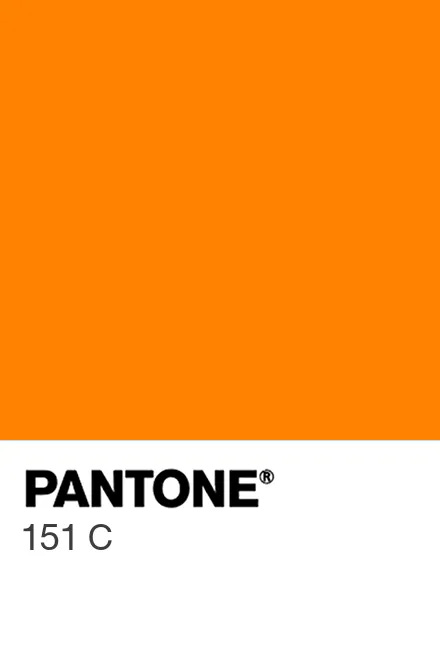
This color is Pantone 151 C.
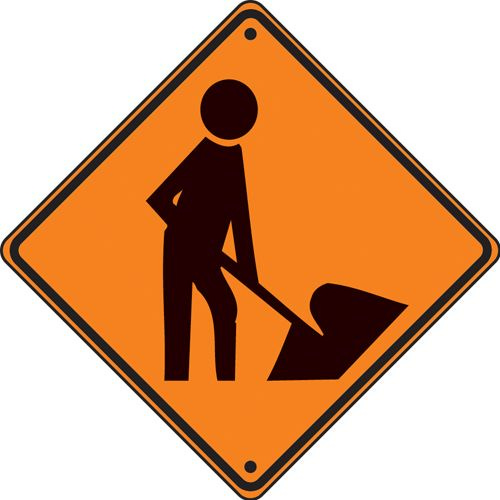
According to the American National Standards Institute, which helps to create standardization in warning labels and more that are used by companies and the federal Occupational Safety and Health Administration, Pantone 151 C is the closest Pantone equivalent to safety orange—the color of traffic cones, construction-zone signs, and other warnings. (Pantone is a company that provides “over 10,000 color standards across multiple materials including printing, textiles, plastics, pigments, and coatings.”)
Safety orange is itself very similar to blaze orange—the color of the vests, hats, and more than hunters don in the fall so they can be detected by other hunters. Fleet Farm, a retail chain that provides farm and hunting goods, explains that blaze orange is slightly different from safety orange. Both colors are “highly visible” with their fluorescent orange hue, but “blaze orange is slightly more reddish and is specifically chosen for hunting gear because it stands out in natural settings.” Blaze orange is also called hunter orange.
Safety orange and blaze/hunter orange are different, although there is variability in the exact shade of hunting gear—and in the exact shade of safety orange on items like traffic cones. Overall, I think Fleet Farm’s assessment that blaze orange is a little redder is accurate.
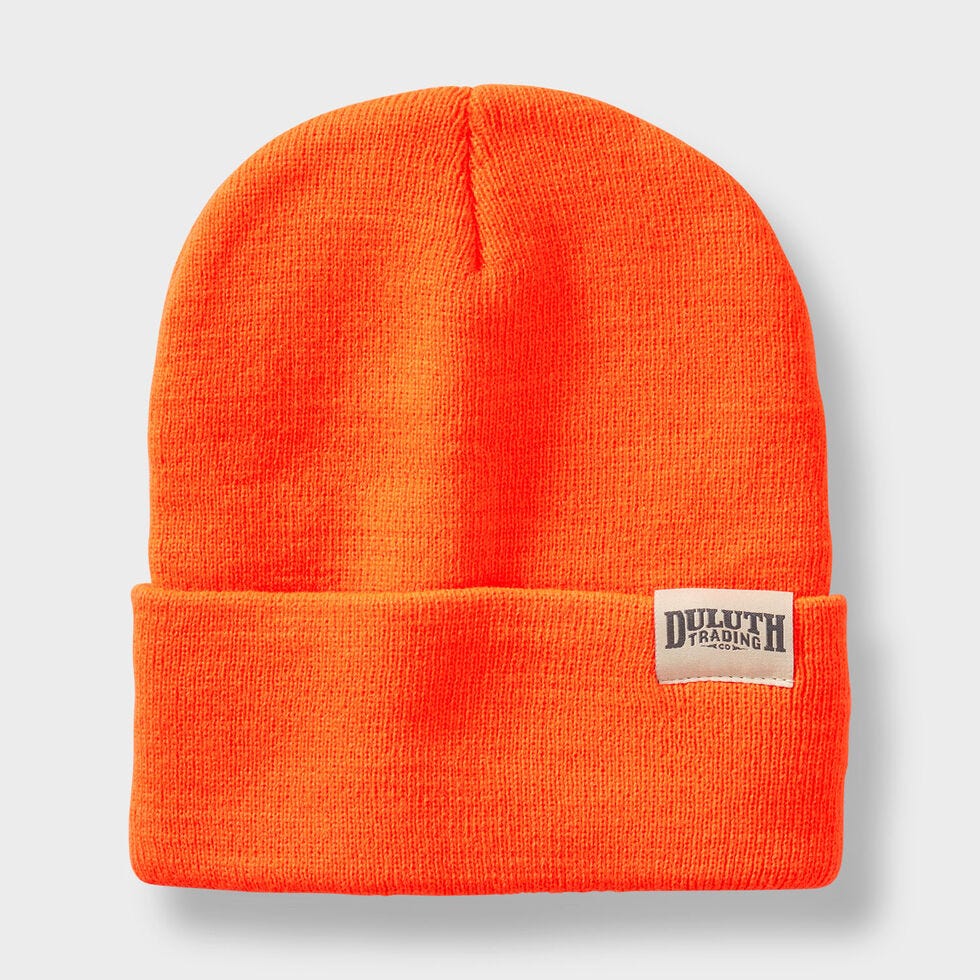
OK, so I should call it a “blaze orange” or “hunter orange” hat.
But should “blaze orange” or “hunter orange” be capitalized?
Pantone capitalizes the names of the colors to which it gives special names. Its Color of the Year for 2020 was a color it termed Classic Blue. Of course, the conventions corporations follow aren’t necessarily what copyeditors endorse—to make the products seems important, corporations love capitals.
Wherever possible, “Chicago has traditionally preferred a sparing use of capitals (what in previous editions has been referred to as a ‘down’ style)” (CMOS 8.1). In other words, if you’re writing in Chicago style—and, in my opinion, you should most of the time, even for more casual writing—don’t capitalize random nouns like a Founding Father would. Only capitalize words if there’s a clear reason to, which in the vast majority of cases means capitalizing only the first word of a sentence and any names.
What exactly is a name, though? “Blaze orange” is the name of a special color used in hunting. I thought that perhaps “blaze orange” deserved capitals since it is a specialized term. Italics, quotation marks, and capitals can signify to the reader that no, you shouldn’t be expected to know this term, and that it has a particular, narrow usage. Italics are usually reserved for foreign-language words, and quotation marks—unless I was using them to refer to the term as a term, as I have been in the paragraphs above—often signify irony.
Since The Chicago Manual of Style doesn’t really cover hunting, I looked up Indiana and Michigan hunting laws to check what the official regulations said.
Both used the term “hunter orange,” with no capitals.
Merriam-Webster doesn’t have an entry for “safety orange” or “hunter orange,” but it does have one for “blaze orange,” and it lowercases the term.
It takes a lot for me to disagree with Merriam-Webster.
For “blaze orange” or “hunter orange,” however, I’m not talking about a designation I made up—or a more vaguely defined color like “bright orange.” The particularity suggests a need for capitalization.
I’m still undecided on this. Please answer the poll below—“Blaze Orange” or “blaze orange.”
Google Books Ngram Viewer—which tracks the frequency with which terms have been used in a corpus of books—suggests that lowercasing is the more common usage.
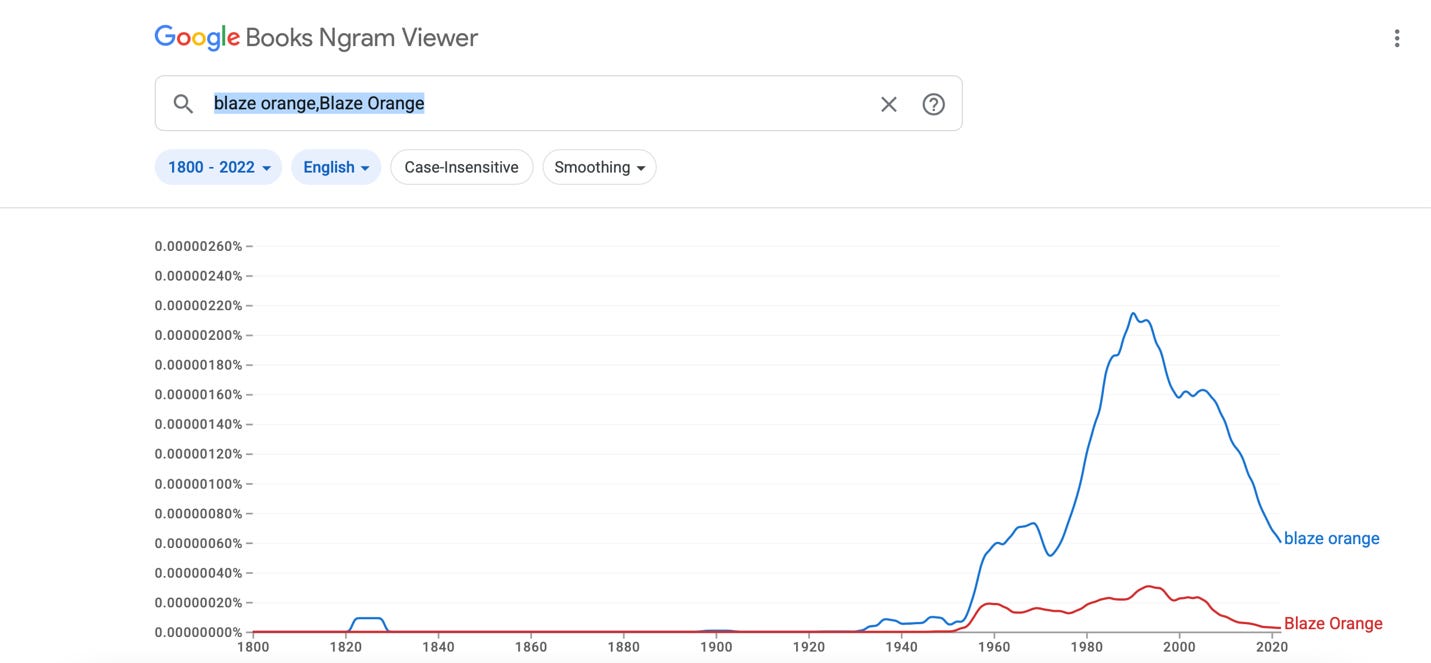
Google Books Ngram search, February 6, 2026
Finally, are “blaze orange” and “hunter orange” interchangeable? Which one is more common? Is there a reason to use one term over the other?
Notice that the Indiana and Michigan laws used “hunter orange,” not “blaze orange.” They didn’t go back and forth between both terms. Some states, such as West Virginia, do use the term “blaze orange.”
Google Ngram is helpful here too, suggesting that “blaze orange” is more common than “hunter orange.”
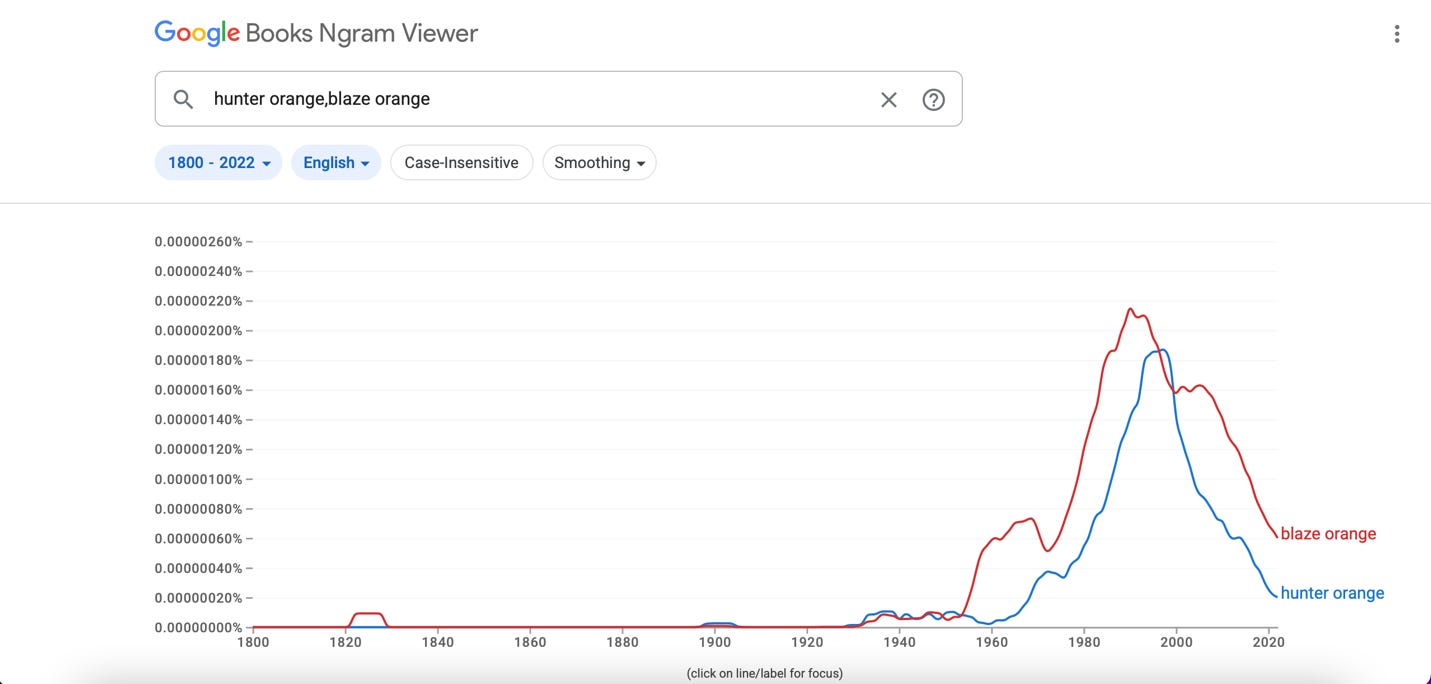
Google Books Ngram search, February 6, 2026
And remember that Merriam-Webster had an entry for “blaze orange,” but not “hunter orange”? Merriam-Webster follows usage, so it would have an entry for the more common word.
All that to say, if you decide to shoot a deer next fall, in my judgment you should describe the hat or vest you put on blaze orange.
P.S. Blaze orange, while it is ubiquitous among hunters now due to legal requirements to wear it, wasn’t always the color of hunting attire. It began to be popularized in the 1960s, after the publication of a 1960 article in Field & Stream called “Hunter Orange—Your Shield of Safety.” Before then, hunters often wore a still-familiar red-and-black pattern called buffalo plaid. For more on hunting in the late nineteenth and twentieth century (specifically Theodore Roosevelt’s apparel while hunting), check out the latest issue of my sister’s newsletter, Missing Pieces.