
Surprised by Italics
Copyediting, Joy, and C. S. Lewis

As 2023 comes to a close, I’m sending along a more meditative, reflective issue. I still plan to return to Jane Austen and the singular they . . . and be on the lookout for a collaboration about capitalization and brand names with my sister’s newsletter, Missing Pieces, next month.
Like millions of other children, I spent many precious hours while I was growing up immersed in the magical world of Narnia.
There I was introduced to countless delights, including Fauns, Centaurs, Talking Beasts, Dwarfs, Aslan, Peter and Susan and Edmund and Lucy, Marsh-wiggles, and . . . italic and roman type styles. Yes, it was the interplay of italics and roman that—in addition to the realms of enchantment—gave me a sensation of Joy. (Despite my preference for the down style, I follow C. S. Lewis’s usage in this paragraph and capitalize the names of generic categories like Dwarfs.)
Is it too dramatic to describe my sensations upon encountering the difference between italic and roman as joyful? I don’t think so—and I think Lewis would be inclined to agree with me.
To Lewis, Joy (he used capitals) goes along with longing—to have an experience of Joy is to have “an unsatisfied desire which is itself more desirable than any other satisfaction” (C. S. Lewis, Surprised by Joy [New York: Harcourt Brace Jovanovich, 1955], 16–17).
One of Lewis’s first experiences of Joy was seeing “the Castlereagh Hills from his nursery windows” (Alan Jacobs, The Narnian: The Life and Imagination of C. S. Lewis [New York: HarperCollins, 2005], 40). The sight was so beautiful that it gave him the desire for more lovely scenes—as well as making him want to experience the source, meaning, and fullness of beauty.

Cregagh Glen, in the Castlereagh Hills in Northern Ireland. Source: Trip Advisor
To experience Joy is to have an intense, imaginative, aesthetic response to something while also longing to experience the beauty, the meaning even more fully and wholly. We can only experience Joy incompletely and fragmentarily—but these fragments give glimpses of the underlying, transcendent reality of Truth and Beauty.
When my italics-related experience of Joy occurred, I was probably seven or eight. I was either in the family room of my childhood home, nestled against the large, commanding built-in solid wood bookcases—or I was in the dim, darker, quieter living room, close to the billowing gossamer curtains. I, like Lewis, am “a product of long corridors, empty sunlit rooms, upstairs indoor silences . . . and endless books” (C. S. Lewis, Surprised by Joy [New York: Harvest, 1965], 10).
In my hands was The Voyage of the Dawn Treader. I admired the deep maroon color of the spine and of the border of the back cover. I stared dreamily at the dreamy scene on the cover, of the ship approaching Aslan’s Country. I don’t think I had read the book before. (It would be more than twenty years before I heard of it, but I was following the Whole Book Approach in my careful examination of these paratextual elements.)
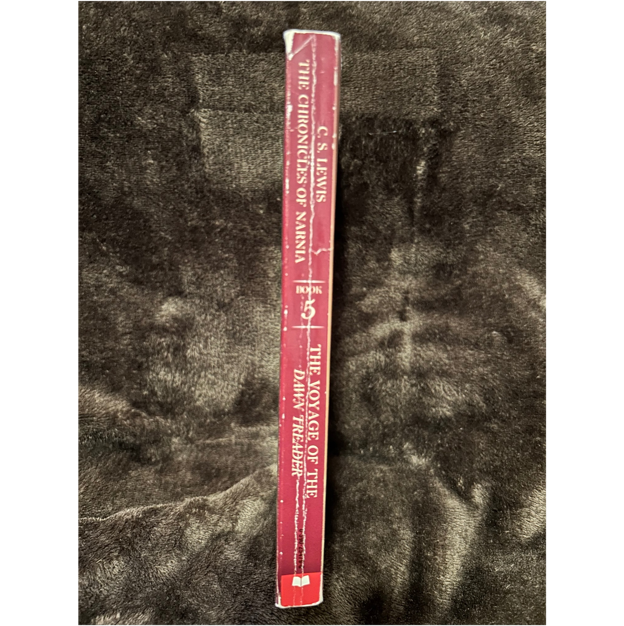
This is the copy that I was looking at. Thanks to my mother for photographing it for me.
I began to read the description on the back of the book. I noticed it had a caption that was mostly in a slanted font: “The Dawn Treader will take you places you never knew existed.”
Why, I wondered, was Dawn Treader not slanted?
If my memory is correct, I next asked my mother this question, and she said that the slanted writing was called italics. She said that the names of ships are in italics, but if the surrounding text is in italics, the part in italics is in regular type, which is also called roman type (sorry, C. S. Lewis, but despite your love of capitals I definitely have to use the down style here for “roman,” as that’s what all copyeditors do).
Putting a title or term that would usually be italicized in roman type when the text surrounding it is in italics is called “reverse italics,” according to The Chicago Manual of Style 8.173.
So, on at the top of the back cover, it said:
The Dawn Treader will take you places you never knew existed.
But below, in the main section of the blurb, there was this sentence:
The Dawn Treader is the first ship Narnia has seen in centuries.
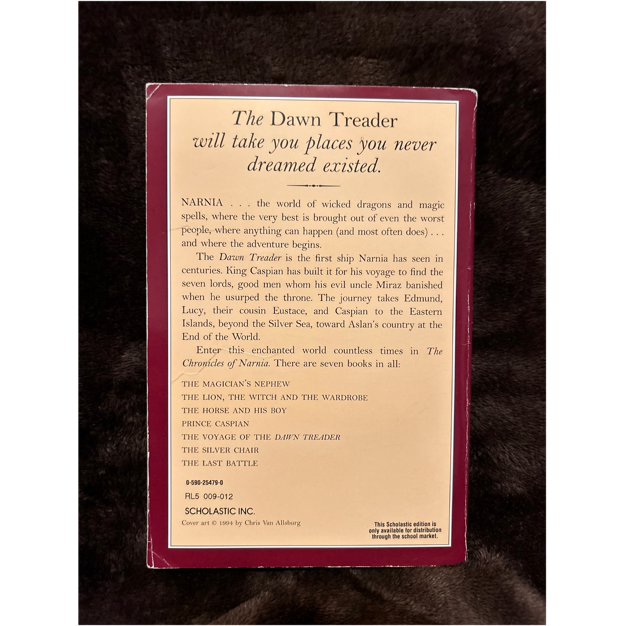
There is an error on this back cover, at least if the conventions of Chicago style are followed. Series titles should not be in italics (CMOS 14.123). Please do me a favor and call the series The Chronicles of Narnia, not The Chronicles of Narnia. (I usually put picture captions in italics but am leaving this caption roman for clarity.)
Looking at these two instances of italics gave me a pleasure analogous to pushing the bubble of a fidget toy in and out, or of turning a shirt inside-out and then back to right-side out.
There was another italics-related question to consider, this one related not just to the name of the ship but to the title, which contains the name of the ship. I don’t think I puzzled it out at that moment, but The Voyage of the Dawn Treader became the book that made me think about italics.
What I learned later is that when you refer to the title of a book, the title of the book is in italics—except if reverse italics are needed (CMOS 14.86). You may have seen the title of the book in question written as The Voyage of the “Dawn Treader”;[1] this is wrong. The title should be The Voyage of the Dawn Treader.
But title pages and covers present the title of a book in roman type style—except for the parts that need italics (see CMOS 1.19 for the elements included on a title page). So the cover of the book said “The Voyage of the Dawn Treader.”
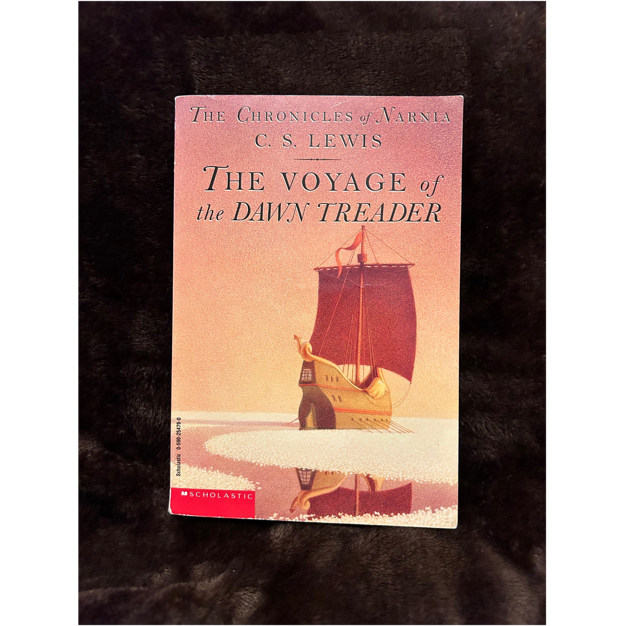
The “of” and “the” are stylized on the cover.
Again, there was the interesting inside-out phenomenon: “The Voyage of the Dawn Treader” is how to refer to the title, but “The Voyage of the Dawn Treader” is how it appears on the title page.
To state what happened as clearly as possible, the back cover and front cover of The Voyage of the Dawn Treader gave me a taste of working with the minutiae of language—formatting, style, grammar, punctuation, spelling. To me the possibilities of the printed page felt glorious.
And this was Joy because we can only work with language one word, one comma at a time—yet those little marks point to the larger truth of conveying meaning. We can’t see the whole of Language, but our beautiful conventions and rules, with their depths of signification, show its powers.
Lewis wrote that his favorite sound was “adult male laughter”—think of the Inklings sitting around a table in a pub, enjoying each other’s company (cited in Jacobs, Narnian, xix).
Well, my favorite sight—beyond the faces of my beloved family members and friends, or an especially lovely landscape or illustration—is printed words on a page. I love all the details—periods and line spaces and letterspaces and paragraph indentation and running heads.
In his memoir, Surprised by Joy, Lewis traces the story of his initial experience of Joy—from the seeing the hills to reading Squirrel Nutkin to learning about Balder the Beautiful, a figure in Norse mythology.
I too can trace a story of copyediting Joy, from the Dawn Treader to my sister buying me a dictionary when I was ten that I diligently pored over, to reading The Economist’s style manual in high school, to working on the document volumes of the official Churchill biography in college.
To C. S. Lewis, I can therefore attribute not only my love of Puddleglum, Reepicheep, and many other mythical creatures but also, more indirectly, my love of copyediting.
The Voyage of the Dawn Treader did take me to places I never knew existed—like the Lone Islands and Aslan’s Country—while also inaugurating another journey into the rules of style and grammar.
Beating through the thicket of the English language, knowing that it leads to Narnia and many beautiful places,
Rebekah Slonim
[1] You should use quotation marks within italics for a title in the following situation: “a title of a work within another title . . . should remain in italics and be enclosed in quotation marks” (CMOS 14.86). Example: Roland McHugh, Annotations to “Finnegans Wake” (Baltimore: Johns Hopkins University Press, 1980) (CMOS 14.94).
I'm so grateful I read books like The Chronicles of Narnia and The Lord of the Rings growing up. Lewis and Tolkien have such a way with language that I learned to love not only the story but also the words that comprised the story. Such a great summation of the delight one can experience reading!
What a delightful journey. I don't think I ever noticed the reverse Italics of the title before. And now I want to go find my own childhood copy to see how the Italics are handled. It's long since lost the dust jacket, though.